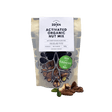


Both are tree nuts. Both grow wild. Both become crunchier, more digestible and more flavorful when activated. And both belong in your daily lineup for completely different reasons. The pecan protects your cells with antioxidants, the Brazil nut supplies your thyroid and immune system with selenium. Not one or the other. Both together.
ORAC value
ORAC stands for Oxygen Radical Absorbance Capacity. It measures how well a food neutralizes free radicals. Free radicals are unstable molecules that damage cells and speed up aging. Antioxidants catch them. The higher the ORAC value, the stronger the cell protection.
Pecan: ORAC 17,940 - highest of any tree nut.
Selenium
Selenium is an essential trace element. Your body needs it but can't make it on its own. It protects cells from oxidative stress (glutathione peroxidase), drives the thyroid (converting T4 to T3) and supports the immune system. Daily requirement sits at 60-70 µg.
Brazil: 50-90 µg per nut. One covers the full daily need.
Why 1-2 Brazil nuts is the ideal amount: selenium is highly potent, but your body only needs a small amount. EFSA sets the upper limit at 255 µg per day. Just 1-2 Brazil nuts deliver 50-180 µg, the full requirement. More simply isn't needed, because the Brazil nut delivers more concentrated selenium than any other food. That's not a downside, it shows how potent it is. The pecan complements this perfectly: it has no upper limit and can be eaten in larger amounts, because its strength lies in antioxidants, not selenium.
What does the ORAC value mean for nuts?
FUNDAMENTALS
ORAC, Oxygen Radical Absorbance Capacity, also measures in nuts how well they can neutralize free radicals. The higher a nut's ORAC value, the greater its antioxidant capacity. It's measured in µmol TE (Trolox equivalents) per 100 grams.
ORAC ranking for nuts:
Pecans: 17,940 µmol TE/100g
Walnuts: 13,541 µmol TE/100g
Pistachios: 7,675 µmol TE/100g
Almonds: 4,454 µmol TE/100g
Cashews: 1,948 µmol TE/100g
Pecans sit right at the top. Not by a hair, but by a clear margin. Nearly twice as much as walnuts, four times more than almonds. And yet they're barely known in Germany, while almonds are on every supermarket shelf.
The pecan: antioxidant champion
PROFILE
The pecan comes from North America and is now also grown in South Africa. Our organic pecans come from South Africa, where Agni has personally visited the farmers and checked the quality on site.
What's behind that ORAC value of 17,940?
Proanthocyanidins (PACs): the same compounds found in red wine and grape seeds. PACs inhibit LDL oxidation, the actual trigger for atherosclerosis. Pecans are the richest nut source of them. In one study, eating pecans raised measurable antioxidant capacity in plasma within hours.
Ellagic acid: a polyphenol that catches researchers' attention because it can promote apoptosis of cancer cells without harming healthy ones. Polyphenols influence molecular signaling pathways like NF-κB, which are central to chronic inflammation.
γ-tocopherol: the form of vitamin E that neutralizes reactive nitrogen species. Especially relevant for protecting nerve cells.
In flavor, the activated pecan sits somewhere between butter and caramel. Fermentation deepens the nutty aroma and breaks down bitter tannins. The crunch after activation is lighter and cleaner than in raw pecans. With 72% fat content, it's the fattiest of all tree nuts. At 2DiE4 we dry below 65 °C so the delicate fatty acids and antioxidants stay intact.
Pecans have no upper limit. A handful a day for steady cell protection.
The Brazil nut: selenium powerhouse
PROFILE
The Brazil nut grows wild in the Amazon rainforest. Ours come from Bolivia. The Brazil nut tree reaches up to 50 meters tall and pulls minerals from soil layers other plants can't reach. That includes selenium, in amounts that don't appear in any other food.
A single Brazil nut contains 50 to 90 µg of selenium. The daily requirement for adults is 60 to 70 µg (EFSA). That means: one Brazil nut a day covers your full selenium needs.
Selenium is built into glutathione peroxidase, one of the most important antioxidant enzymes. It plays a direct role in thyroid function (converting T4 into the active form T3) and supports the immune system. Combined with the antioxidants in pecans, you get a double-layered protective effect for your cells.
In flavor, the activated Brazil nut is creamy, buttery and rich. The activation process breaks down phytic acid, so your body can absorb the selenium even better.
Because Brazil nuts deliver such concentrated nutrition, 1 to 2 pieces a day is enough. That's not a limitation, it shows how potent this nut is. Your body simply doesn't need more.
On natural radioactivity
Brazil nuts contain small amounts of natural radium-226 from the soil. The levels vary significantly depending on the region of origin. Our Bolivian Brazil nuts have considerably lower levels than nuts from some other parts of the Amazon.
With 1 to 2 pieces a day, the annual radiation dose comes out to roughly 160 µSv. The natural background radiation every person is exposed to continuously is 2,100 µSv per year. A single long-haul flight carries more radiation than a full year of Brazil nuts. At the recommended intake, it's simply not a relevant factor.
Stronger together: the nut duo
COMBINATION
Pecan
Strength: antioxidants (ORAC 17,940)
Protects: cells, blood vessels, nervous system
Taste: buttery, caramel, mild
Recommended: a handful a day
For everyone. No upper limit.
Brazil nut
Strength: selenium (50-90 µg per nut)
Protects: thyroid, immune system
Taste: creamy, buttery, rich
Recommended: 1-2 pieces a day
Highly concentrated. A little goes a long way.
The optimal combination: a handful of pecans for antioxidant protection, plus 1 to 2 Brazil nuts for selenium. Different strengths, different active compounds, together a broad spectrum of protection. That exact combination is in our nut mix, in the right portion.
Both strengths in one mix
2DiE4 activated organic nut mix
Pecans, Brazil nuts, cashews, walnuts and almonds. All activated, all organic. The Brazil nuts in the recommended daily amount, the pecans for an antioxidant boost. A handful a day.
Discover the nut mix →Pecans + Brazil nuts + 5 more varieties
2DiE4 ALL-IN-ONE set
7 x 100 g · Free shipping DE/AT · ★★★★★ 4.9/5
10 questions and answers
NUT WISDOM
1. What is the ORAC value?
ORAC stands for Oxygen Radical Absorbance Capacity. It measures a food's antioxidant capacity, meaning how well it neutralizes free radicals. The higher the value, the stronger the cell protection. Pecans sit at 17,940, the top of all tree nuts.
2. Why are pecans so unknown in Germany?
They don't grow in Europe (main production: USA, Mexico, South Africa). Imports cost more than almonds or walnuts. In the US they're everywhere (pecan pie). In Germany the tradition simply isn't there, even though the nutritional profile is outstanding.
3. How many pecans per day?
20-30 g (roughly 10 halves) is a solid daily amount. There's no defined upper limit. One study showed that eating them raised measurable antioxidant capacity in plasma within hours.
4. How many Brazil nuts per day?
1 to 2 pieces a day. That covers your full selenium needs. It shows how concentrated the Brazil nut is. Your body doesn't need more, and at this amount it's a genuine superfood. How many Brazil nuts a day?
5. What are proanthocyanidins?
Polyphenols that also appear in red wine and grape seeds. They inhibit LDL oxidation and protect the inner wall of blood vessels. Pecans are the richest nut source. Activation breaks open the cell walls and makes the PACs more bioavailable.
6. What does your body need selenium for?
Selenium is essential for cell protection (glutathione peroxidase), the thyroid (converting T4 to T3) and the immune system. The Brazil nut is by far the best natural source of selenium. Selenium from Brazil nuts is in the form of selenomethionine, a form your body absorbs especially well.
7. Do Brazil nuts contain natural radioactivity?
Brazil nuts contain small amounts of natural radium-226 from the soil. Levels vary significantly depending on origin. Our Brazil nuts come from Bolivia with considerably lower levels. With 1 to 2 pieces a day, the radiation sits far below natural background radiation. You'd have to eat large amounts over a long period to reach meaningful territory.
8. Can kids eat both nuts?
Yes. Pecans and Brazil nuts are suitable for children as soon as they can eat nuts in general (whole nuts from 4-5 years, earlier as butter or chopped over muesli and yogurt). For Brazil nuts, half a nut a day is enough selenium for kids. Kids' guide.
9. Does activating make a difference?
Yes, for both. Pecans: activation breaks open cell walls and makes proanthocyanidins more bioavailable. Brazil nuts: phytic acid is broken down, so your body absorbs the selenium better. And in taste, both become noticeably crunchier and more flavorful.
10. Do you have both in one product?
Yes. The 2DiE4 nut mix packs pecans and Brazil nuts together with cashews, walnuts and almonds, in the recommended daily amount. If you want to try all 7 varieties, go for the ALL-IN-ONE set (49,90 € instead of 64,30 €).
Sources:
- USDA FoodData Central: ORAC values for tree nuts
- Bolling, B.W. et al. (2011): Tree nut phytochemicals. Nutrition Reviews
- Hudthagosol, C. et al. (2011): Pecans increase plasma antioxidant capacity. Journal of Nutrition
- EFSA Panel on Dietetic Products, Nutrition and Allergies: Scientific Opinion on Dietary Reference Values for Selenium. EFSA Journal, 2014
- Thomson, C.D. et al. (2008): Brazil nuts: an effective way to improve selenium status. American Journal of Clinical Nutrition
- Rayman, M.P. (2012): Selenium and human health. The Lancet
- Preedy, V.R. & Watson, R.R. (2020): Nuts and Seeds in Health and Disease Prevention, 2nd Edition. Academic Press