

When can children eat nuts? Safe by age
5 min read 2DiE4 Live Foods · 2DiE4 Live Foods Updated:30 Jun 2026Share
Nuts are dense in nutrients, healthy fats and protein. That's exactly why so many parents ask: when can my child join in? The short answer depends less on age than on the form in which the nut reaches the plate.
The short answer
Whole nuts belong on the menu only from around 4 to 5 years because of the choking hazard. Finely ground nuts, nut butter and nut paste, on the other hand, may be added in small amounts from the start of solid foods, so from about the 6th month. Introducing them early in this safe form can even lower the risk of a nut allergy.
Why nuts are so valuable for children
Nuts are small nutrient packages. They provide high-quality plant protein, unsaturated fats and a range of trace elements that matter during growth:
- Plant-based omega-3 (ALA): above all in walnuts. This fatty acid is a building block for the brain and nerve cells.
- Selenium: Brazil nuts are the strongest natural source. Selenium supports the immune system and the thyroid. Here, very small amounts are enough.
- Magnesium and zinc: for muscles, nerves and a normal immune system.
- Iron: important for blood formation and concentration, and well supplied by cashews and almonds.
- Vitamin E: an antioxidant that protects the cells.
Nut Nutrition Calculator
How much omega-3, selenium or magnesium is in which nut? Choose a variety and an amount and see the nutritional values straight away, free and without signing up.
Open the Nut Nutrition CalculatorWhy whole nuts only from 4 to 5 years?
A whole nut is hard, smooth and round. Exactly the properties that make it dangerous for small airways. Children under four cannot yet grind reliably with their molars and choke easily. A nut that has been inhaled is hard to remove again and can block the airways. Paediatric associations therefore advise uniformly to give no whole or coarsely chopped nuts until about the age of 4 to 5 (German Association of Paediatricians, BVKJ).
The same applies to similarly shaped foods: whole grapes, raw carrot pieces, popcorn and hard sweets.
Nut butter and ground nuts from the start of solids
In ground form or as a smooth paste, the choking hazard disappears. That means nuts can come in early: from about the 6th month, as soon as your child starts on solid foods. For a long time the advice was to delay allergenic foods. Today the evidence is the other way round: the well-known LEAP study (Du Toit et al., New England Journal of Medicine 2015) showed that the early and regular introduction of peanut clearly lowers the risk of allergy. Bodies such as the EAACI have adjusted their recommendations accordingly.
In practice that means stirring a teaspoon of fine almond, hazelnut or cashew butter into purée, yoghurt or porridge. Smooth, thinly spread, not by the spoonful on its own.
Nuts for children: the overview by age
| Age | Safe form | Not yet |
|---|---|---|
| from approx. 6 months | Smooth nut butter, finely ground nuts, thinly stirred in | Whole and chopped nuts |
| 1 to 3 years | Nut butter, finely ground nuts in baking or muesli | Whole and chopped nuts |
| 4 to 5 years | Gradually whole nuts, if the child chews well and sits calmly | Nuts on the go, while walking or playing |
| from 5 years | Whole nuts as a snack | - |
How do I introduce nuts safely?
- One variety at a time. That way you notice if your child reacts to a particular nut.
- Start small. A teaspoon of butter is enough at first. Increase slowly if it is well tolerated.
- Keep at it. Allergy prevention works through regular, repeated small amounts, not through a single attempt.
- Always seated, always supervised. Never let them eat on the side.
Important: take nut allergies seriously
Nuts are among the most common triggers of food allergies. So introduce each variety on its own and watch your child closely. Look out for skin rash, swelling in the face, vomiting, stomach ache or breathing problems. If there is an increased risk, for example severe eczema or known allergies in the family, speak to your paediatrician before the first attempt.
If you want to introduce nuts step by step when there is an increased allergy risk, you'll find the detail in Nut allergy in children.
Reliable sources for parents:
- nussallergie.org: allergy management
- Apotheken Umschau: nut allergies, causes, symptoms and everyday tips
Are activated nuts better for children?
Activated nuts are soaked and gently dried. In the process a large part of the phytic acid is broken down, the substance that binds minerals and makes nuts harder to digest. For children this can improve digestibility. Activation does not change the safety rule, though: even activated whole nuts stay off the table until about the age of 5. For the youngest, the ground form or the butter still applies.
For the first spoonfuls of nut
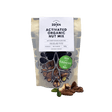
Finely ground, easily tolerated nuts work best. Our activated organic almonds and the organic nut mix can be processed fresh into a smooth paste, with no additives, no oil, no sugar.
View activated organic nutsFrequently asked questions
When can babies eat nuts?
As smooth nut butter or finely ground from the start of solids, so from about the 6th month. Whole nuts only from about 4 to 5 years.
When can children eat whole nuts?
From about 4 to 5 years, when the child chews safely and sits calmly while eating. Before that there is a choking hazard.
From when can babies have nut butter or almond butter?
From the start of solids around the 6th month, stirred in thinly and smoothly into purée, porridge or yoghurt.
When can children eat walnuts or almonds?
The rule depends on the form, not the variety: ground or as a paste early on, whole only from about 5 years.
Are nuts good for children?
Yes. Nuts provide high-quality protein, unsaturated fats, plant-based omega-3 and trace elements such as selenium, magnesium and zinc. Only the age-appropriate form is decisive.
Read more
Sources
- Du Toit G et al. Randomized Trial of Peanut Consumption in Infants at Risk for Peanut Allergy (LEAP). N Engl J Med 2015;372:803-813.
- EAACI Guidelines on Allergen Immunotherapy and Prevention of Food Allergy.
- German Association of Paediatricians (BVKJ): guidance on the choking hazard from nuts in young children.
- German Federal Centre for Nutrition (BZfE): solid foods and allergenic foods.