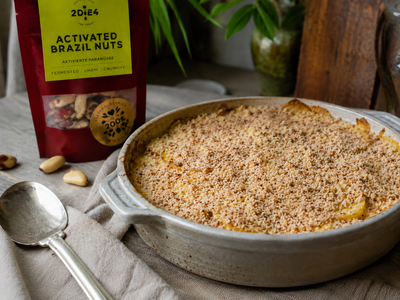




The walnut looks like a brain.
That is a coincidence. The fact that it protects it is science.
In the podcast with Hadrian Thomas from Katana Studio, we talked about the walnut, and I said: "Walnuts is where we believe you can feel the difference the biggest." Bitter, slightly oily conventional walnuts versus our activated ones, where the bitterness disappears and the nutty, creamy flavor comes through. At 2DiE4, we call the walnut the "gateway drug" into the world of activated nuts.
But today is not just about taste. Today is about why the walnut is the only food that protects your brain on three levels at the same time.
8-14% omega-3. No other nut even comes close.
THE NUMBERS
Alpha-linolenic acid, ALA, makes up 8-14% of the total fat in walnuts. That is unique among all tree nuts. Almonds? Practically no omega-3. Cashews? Negligible. Pistachios? Minimal. Only the walnut plays in this league.
30 g of walnuts provide 2.7 g of ALA. The daily requirement is 1.6 g. So you exceed it with 7 walnut halves. And your brain urgently needs this ALA: part of it is converted into DHA, the main building block of nerve cell membranes. Without enough DHA, these membranes become rigid, and signal transmission between neurons slows down. Concentration, memory, and mood suffer.
Then there is γ-tocopherol, a special form of vitamin E that is especially concentrated in walnuts. While most supplements contain α-tocopherol, it is γ-tocopherol that neutralizes reactive nitrogen species, a type of free radical that damages nerve cells particularly aggressively.
708 people, 2 years, MRI scans
THE WAHA STUDY
The Walnuts and Healthy Aging Study (2020) is the largest randomized controlled study on this topic to date. 708 healthy older adults in Barcelona and Loma Linda. One half ate 30-60 g of walnuts per day, the other did not. For two years.
The results were clear:
- Significantly better cognitive test results in the walnut group
- Less brain atrophy in MRI scans, the brain shrank measurably more slowly
- Lower inflammatory markers in the blood
- The effect was especially strong in participants who had previously consumed little omega-3
I want to be honest: most brain studies on nuts are animal studies. The WAHA study is one of the few conducted in humans. And it is promising, but not conclusive. What we do know for sure: walnuts provide a nutrient profile that no other snack offers in this combination. What we do not yet know: whether this prevents dementia in the long term.
Three protective mechanisms. One nut.
NEUROPROTECTION
01
Anti-inflammatory effect
Ellagitannins from walnuts are converted in the gut into urolithins. These cross the blood-brain barrier and inhibit NF-κB, the central inflammatory switch. Walnut extract reduced inflammatory markers in the brain by up to 40%.
02
Oxidative protection
The brain uses 20% of the body's oxygen while accounting for only 2% of body mass. That makes it vulnerable to oxidative damage. γ-tocopherol, melatonin, and polyphenols from walnuts form a triple antioxidant shield.
03
Gut-brain axis
Polyphenols promote butyrate-producing bacteria in the gut, which communicate directly with the brain via the vagus nerve. 95% of serotonin is produced in the gut. Read more.
Why roasting
destroys the brain potential
THE DECISIVE POINT
In the podcast, Agni explains what happens in industrial processing facilities: the nuts are dried at well over 100 °C in huge cylinders. Fast, efficient, cheap. "What you buy as raw in the supermarket is not a raw nut," she says.
For the omega-3 fatty acids in walnuts, this is devastating. ALA is the most heat-sensitive of all fatty acids. At temperatures above 150 °C, it oxidizes and forms lipid peroxides, which damage exactly the nerve cells it is supposed to protect. Instead of antioxidants, you get pro-oxidants.
Our activated walnuts: What we do differently
It took two years before we sold our first product. Two years of trials with water, salt, temperatures, ovens. The ovens are now in their fourth version, custom-made, because there was nothing on the market that met our standards.
Spring water from the farm. Sea salt from Brittany. A maximum of 65 °C. Two and a half days of drying time. More air than temperature. The ALA omega-3 profile remains fully intact. And phytic acid, which would otherwise block zinc and magnesium, both essential for neurotransmitter production, is reduced by up to 60%.
Filip in the podcast: "We are on version four of the ovens. And we are still improving. Every harvest is different. But I think we are 90% there. The last 10% is fine-tuning."
30 g. 7 halves. Every day.
PRACTICE
This is what 30 g of activated walnuts provide:
- 2.7 g ALA omega-3 (170% of the daily requirement)
- 5.4 mg γ-tocopherol (nerve cell protection)
- Ellagitannins for the gut-brain axis
- Melatonin for better sleep, and sleep is essential for brain regeneration
In your muesli in the morning. As a snack in the afternoon. With salad in the evening. In the podcast, Agni says: "It changes all the time for me. Sometimes only pistachios, then almonds. I listen to my body." Our Portuguese farmer does something similar: he puts different varieties on the table and lets the children choose. The children instinctively reach for the best one.
Your body knows what your brain needs. Give it the choice. Our organic nut mix contains walnuts together with cashews (magnesium for GABA), almonds (vitamin E), and Brazil nuts (selenium for the thyroid).
Your brain needs omega-3. The walnut provides it. Activation preserves it. That simple.
All varieties. One set. Save 22%.
2DiE4 ALL-IN-ONE Set
Walnuts + Cashews + Pistachios + Almonds + Pecans + Pumpkin Seeds + Nut Mix
★★★★★ 4.9/5 · 62+ reviews · Free shipping in DE/AT
10 Questions and Answers
NUT KNOWLEDGE
1. How many walnuts per day for the brain?
7 walnut halves (30 g) provide 2.7 g of ALA omega-3, which is 170% of the daily requirement. The WAHA study used 30-60 g per day and showed measurable improvements after 2 years in 708 participants.
2. What exactly is ALA, and why does my brain need it?
ALA, alpha-linolenic acid, is a plant-based omega-3 fatty acid. Your body partially converts it into DHA, the main building block of nerve cell membranes. Without DHA, these membranes become rigid and signal transmission between neurons slows down.
3. Can walnuts prevent Alzheimer's?
Research shows that walnuts reduce oxidative stress and neuroinflammation, both major drivers of neurodegenerative diseases. Prevention has not yet been conclusively proven scientifically, but the WAHA study showed less brain atrophy in MRI scans.
4. What happens to omega-3 when walnuts are roasted?
ALA is the most heat-sensitive fatty acid. At roasting temperatures above 150 °C, it oxidizes and forms lipid peroxides and free radicals. Instead of brain protection, you get the opposite. Activated walnuts are dried below 65 °C.
5. What are urolithins, and why are they important?
Urolithins are produced when your gut bacteria metabolize the ellagitannins from walnuts. They are among the few compounds that can cross the blood-brain barrier and directly inhibit inflammation there. A fascinating mechanism of the gut-brain axis.
6. Walnuts or fish oil: Which is better for the brain?
Fish oil delivers EPA and DHA directly. Walnuts provide ALA, the precursor, plus polyphenols, γ-tocopherol, and melatonin, which fish oil does not contain. For vegans and vegetarians, walnuts are the most important plant-based source of omega-3. Ideally, you combine both.
7. Do walnuts contain melatonin?
Yes. Not as much as pistachios, which hold the melatonin record, but enough for an additional sleep-supporting effect. Good sleep is the most important recovery phase for the brain.
8. Why do conventional walnuts taste bitter?
Tannins in the nut skin cause the bitterness. During activation, these tannins are partially broken down. The result: a milder, nutty-creamy flavor with umami notes. In the podcast, we say: walnuts are the "gateway drug" to activated nuts because the taste difference is greatest here.
9. Which combination is optimal for the brain?
Walnuts (omega-3) + cashews (magnesium for GABA regulation and neurotransmitters) + Brazil nuts (selenium for the thyroid, which regulates brain metabolism). All three are included in the nut mix.
10. Where can I get all varieties in one package?
The 2DiE4 ALL-IN-ONE Set contains 7 varieties of activated organic nuts, including walnuts. 49,90 € instead of 64,30 € (22% off). Free shipping in DE/AT. From our farm in Bavaria straight to you.
Further reading from the Nut Knowledge series:
Sources:
- Sala-Vila, A. et al. (2020): WAHA Study - Effect of 2-year walnut consumption on cognitive decline. AJCN, 111(3)
- Kris-Etherton, P.M. (2014): Walnuts decrease risk of cardiovascular disease. Journal of Nutrition, 144(4)
- Zhao, G. et al. (2004): Dietary alpha-linolenic acid reduces inflammatory and lipid CVD risk factors. Journal of Nutrition, 134(11)
- Ros, E. et al. (2004): A walnut diet improves endothelial function. Circulation, 109(13)
- Real Food Rebels Podcast (2025): Filip Good & Agni Thalgott, Katana Studio
Scientific sources:
- Pribis, P. & Shukitt-Hale, B. (2014): Cognition: the new frontier for nuts and berries. American Journal of Clinical Nutrition, 100(Suppl 1), 347S-352S. PubMed
- Sala-Vila, A. et al. (2020): Effect of a 2-year diet intervention with walnuts on cognitive decline. American Journal of Clinical Nutrition, 111(3), 590-600. PubMed
- Chang, S.K. et al. (2016): Nuts and their co-products: The impact of processing on bioactives and health. Nutrition Reviews, 74(10), 659-690. PubMed