
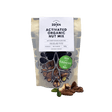


The nutrition label doesn't lie.
But it shows what's in the nut. Not what actually reaches you.
Phytic acid (inositol hexaphosphate, IP6) is how seeds, nuts, and grains store phosphorus. It's not a flaw of nature. It's a brilliant protection mechanism: the plant stockpiles phosphorus for germination and shields the seed from sprouting too early.
The problem for us: phytic acid is a powerful chelator. It binds divalent cations in the gut — iron (Fe²⁺), zinc (Zn²⁺), magnesium (Mg²⁺), calcium (Ca²⁺). The human gut can't break these complexes apart. They pass through unused. Research shows phytic acid reduces zinc absorption by 40-60% and iron absorption by 50-80%.
The other side: phytic acid as an antioxidant
THE PARADOX
Recent research has shown that phytic acid isn't purely bad. IP6 has documented antioxidant properties. It binds free iron that would otherwise generate highly reactive hydroxyl radicals through the Fenton reaction. Too much free iron in the body is dangerous, especially for people with hemochromatosis.
The honest answer: phytic acid is neither pure villain nor pure hero. The real question is how much makes sense. For most people in Western societies, who are already running borderline zinc and iron levels (26% magnesium deficiency, 14% zinc deficiency per NVS II data), the mineral blockade outweighs the benefit.
How soaking and fermentation break the blockade
THE SOLUTION
When a seed germinates, it activates an enzyme called phytase. Phytase cleaves phytic acid and releases the bound minerals. Activation taps into exactly this process:
Research shows phytic acid can reduce zinc absorption by 40–60% and iron absorption by up to 80%, depending on the phytate-to-mineral ratio of the meal (Hurrell & Egli 2010; Lönnerdal 2000). Even a few milligrams of phytate per meal produce measurable effects on non-heme iron uptake (Hallberg et al. 1987).
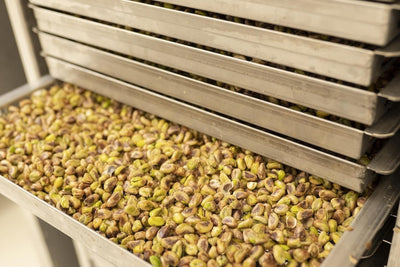
The breakdown of phytic acid starts the moment the seed takes up water and shifts into germination mode. That's when it activates its own phytase enzyme, which cleaves the phytic acid and frees the bound minerals. Our enzymatic fermentation uses exactly this mechanism: soaking in a brine of spring water and hand-harvested sea salt creates the optimal pH range for phytase activity (pH 4.5–5.5). Gentle drying below 65 °C then preserves the enzyme activity and locks in the result (Schlemmer et al. 2009).
Important note: this isn't microbial fermentation like sauerkraut or kimchi. It's an enzymatic activation of the nut's own germination metabolism — without letting it finish. More detail in the ultimate guide to soaking.
At 2DiE4, we use spring water from our farm at Gut Mooseurach and hand-harvested sea salt, followed by slow drying in custom-built dehydrators. The results are reproducible and consistent, the product of over 15 years of process refinement.
What this means for your nutrient supply
IN PRACTICE
If you eat 30 g of raw nuts a day, your body absorbs about 40-50% of the minerals listed on the package. With activated nuts, it's 70-90%. Take cashews as a concrete example: instead of 50 mg of usable magnesium, you get 65-75 mg from the same handful.
This matters especially for vegans (plant-based iron and zinc are already less bioavailable), athletes (magnesium and zinc lost through sweat), pregnant women (higher need paired with the same blockade), and kids (smaller portions = even fewer minerals per bite).
10 questions and answers
NUT WISDOM
1. What is phytic acid?
It's how seeds and nuts store phosphorus. It binds iron, zinc, magnesium, and calcium in your gut and cuts absorption by 40-80%. A natural defense for the plant that becomes a problem for humans.
2. How much of the minerals does phytic acid actually block?
Studies show 40-60% of zinc and 50-80% of iron can be blocked by phytic acid. For magnesium it's 20-40%. In other words: the nutrition label shows more than your body actually takes in.
3. Can I soak and dry nuts at home?
In principle, yes. Temperature control during drying is the tricky part. Above 65 °C you lose the enzymes. Below about 45 to 50 °C, certain enzymatic processes never get fully triggered. The nut can't reach its full potential. That's why professional activation under controlled conditions delivers not just consistent but optimal results.
4. Is phytic acid all bad?
No. It has antioxidant properties and binds excess free iron that would otherwise form hydroxyl radicals. For people with solid mineral status, some phytate can be beneficial. For most Germans (26% magnesium deficiency), the downside wins out.
5. What is phytase?
An enzyme that cleaves phytic acid and releases the bound minerals. It activates when a seed germinates. Soaking in salt water at pH 4.5-5.5 is the sweet spot for phytase activity.
6. Do all nuts contain the same amount of phytic acid?
No. Almonds and walnuts carry relatively high amounts, pistachios and cashews less. But every variety benefits from activation, because it also breaks down enzyme inhibitors that slow digestion independently of phytic acid.
7. Why do some people struggle with raw nuts?
Phytic acid and enzyme inhibitors slow digestion and can cause bloating, heaviness, and intolerance. At 2DiE4, 9 out of 10 people with a nut intolerance report they can digest our activated nuts without any issues.
8. How long do you need to soak nuts?
Between 2 and 12 hours depending on the variety. Almonds need longer than cashews. Salt concentration, water temperature, and the drying method that follows matter just as much. At 2DiE4, we've spent over 15 years dialing in the right parameters for every variety.
9. Does activation make nuts more expensive?
Yes. Real activation takes time, care, and the right conditions. But the difference starts even earlier — with the nut itself. We work only with top-tier organic nuts in 100% raw quality. Because only nuts that are still truly viable can be meaningfully activated and develop the difference that sets them apart from a conventional nut. That's where the natural umami flavor, the perfect crunch, and the quality 2DiE4 stands for all come from.
10. Where can I try every activated variety?
The 2DiE4 ALL-IN-ONE set contains 7 varieties for 49.90 € instead of 64.30 €. Every variety with reduced phytic acid for maximum mineral absorption.
Sources:
- Hurrell R, Egli I. (2010): Iron bioavailability and dietary reference values. Am J Clin Nutr 91(5):1461S–1467S. DOI
- Lönnerdal B. (2000): Dietary factors influencing zinc absorption. J Nutr 130(5):1378S–1383S. DOI
- Hallberg L, Rossander L, Skånberg AB. (1987): Phytates and the inhibitory effect of bran on iron absorption in man. Am J Clin Nutr 45(5):988–996. PubMed
- Schlemmer U et al. (2009): Phytate in foods and significance for humans. Mol Nutr Food Res 53 Suppl 2:S330–S375. DOI
- Sandberg AS. (2002): Bioavailability of minerals in legumes. Br J Nutr 88 Suppl 3:S281–S285. DOI
- Greiner R, Konietzny U. (2006): Phytase for food application. Food Technol Biotechnol 44(2):125–140.