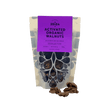
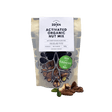
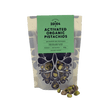

So what are activated nuts, exactly?
Nuts are seeds. Inside a seed, everything a plant needs to get started is stored, fats, proteins, minerals. At the same time, the seed protects itself from premature access, among other things through phytic acid and other antinutrients.
Activating means: the nut is signalled through water, time and controlled conditions that germination may begin. In English terminology this is called sprouting (sprouted nuts). The goal is a natural breakdown of the nut, without roasting.
- Raw: fully in dormancy, antinutrients unchanged
- Roasted: higher temperatures, different aroma, potentially more fat oxidation
- Activated, sprouted: enzymatically fermented and gently dried
Search terms that mean the same thing: activated nuts, germinated nuts, sprouted nuts (activated nuts), activated nuts.
The science behind activation:
phytic acid and mineral binding
What is phytic acid?
Phytic acid is the natural storage form of phosphorus in seeds, nuts and legumes. It serves an important function for the seed, but it also binds minerals such as iron, zinc, magnesium and calcium. This binding can mean that our body absorbs these minerals less efficiently. In nutrition science, phytic acid is therefore described as an antinutrient, not because it is inherently “bad”, but because it can reduce mineral bioavailability, especially in predominantly plant-based diets.
When activating nuts, the aim is to deliberately reduce this natural protective mechanism. Through water, salt, time and enzymatic activity, phytic acid is broken down or transformed. This is exactly where processes such as germinating, sprouting and fermentation come in, here in the sense of an enzymatic, not microbial, fermentation.
Why soaking alone is often not enough
Soaking is the first step to rehydrate nuts and bring them out of dormancy. This can activate the nut’s own enzymes, such as phytase. In practice, soaking alone is often not sufficient to significantly reduce phytic acid.
Because: for phytase to work optimally, it needs specific conditions, above all a slightly acidic pH (around 4.5–5.5). Normal tap water is usually neutral to slightly alkaline and therefore does not provide the best conditions for this enzymatic breakdown.
This is where salt comes into play. Soaking in a salt solution shifts the pH of the water slightly downwards. This creates more favourable conditions for phytase activity and supports the breakdown of phytic acid. Salt also helps inhibit unwanted microbes and stabilises the soaking process without impairing the nut’s ability to sprout — an effect that is much weaker when soaking in plain water.
How strong this effect is depends on several factors: the quality and viability of the raw materials, temperature, soaking duration, pH, and the actual enzyme activity in the seed. Studies show that soaking can trigger processes, but the reduction of phytic acid often remains limited.
Sprouting and fermentation go further. During sprouting, enzymatic activity increases significantly, especially phytase activity. Fermentation additionally lowers pH and supports the enzymatic breakdown of phytic acid as well as other antinutrients and potential allergens. That is why the scientific literature often describes sprouting and fermentation as more effective than soaking alone.
What does that mean in practice?
If the primary goal is a reduction of phytic acid and better mineral bioavailability, sprouting and fermentation are considered more effective than soaking alone.
If the goal is mainly better digestibility, many people also report positive effects from activated nuts, even though the degree of phytic acid reduction varies by nut type.
Activation deliberately combines these processes: soaking (germinating) brings the nut out of dormancy, sprouting and fermentation activate enzymes and break down antinutrients.
During the gentle drying that follows, enzymatic fermentation continues. In the end, the nut is stabilised — with long shelf life and full nutrient power.
The outcome is nuts that are easier to digest and offer increased nutrient bioavailability, plus natural umami flavour and crunch.
Two-stage fermentation:
the 2DiE4 Live Foods activation process (sprouted nuts, activated nuts)
2DiE4 Live Foods works with a controlled two-stage fermentation. This is more than soaking, it is a precise process, developed and perfected over years, with clear parameters for each nut variety, batch and season.
Stage 1: activation in a mixture of pure spring water and sea salt
The viable nuts in raw quality are soaked first in a carefully tuned salt solution. 2DiE4 Live Foods uses in-house spring water and works with controlled timings for each variety. Hand-harvested sea salt supports process stability and is a central component of 2DiE4 activation.
Stage 2: gentle drying
After fermentation, the nuts are dried at temperatures below 65 °C in specially developed dehydrators. During drying, enzymatic fermentation continues — unlocking the signature 2DiE4 flavour with natural umami and perfect crunch. At the same time, the texture is preserved and sensitive nutrients are protected.
At home, temperature, humidity and sprouting pressure (microbial risk) are rarely stable enough. This creates variation in results, flavour and safety.
A standard oven does get warm, but it cannot actively remove moisture, which prevents gentle drying.
Dehydrators are better suited, but they are often imprecise in timing, airflow and temperature control.
A precise temperature curve, like the one used by 2DiE4 Live Foods, cannot be achieved that way.
A controlled process is reproducible, scalable by batch, and designed for consistent quality.
Premium organic raw food quality, sustainability, craftsmanship
Activation only works with excellent, viable raw materials. 2DiE4 Live Foods processes premium organic nuts from sustainable farming, in controlled raw quality. Production is deliberately slow food, careful and done with craftsmanship, with consistent batch control.
- Sustainable: transparent sourcing, vetted partners, responsible processing
- Controlled farming: 100% raw food quality, organically certified, quality over volume
- Spring water: activation with pure spring water from our own source
- Experience: years of development and refinement of the activation process
- Craftsmanship: soaking, dehydrating, sorting, checking, refining, in small, controlled batches
The benefits:
digestibility, performance, flavour
Gut health, gut-friendly
Many people love eating nuts, but do not always tolerate them well. Activation can help because the seed is “kick-started” and antinutrients can be reduced. The goal is a snack that feels lighter, sits less “heavy” in the stomach, and fits better into sensitive routines.
Sport and performance
Nuts provide fats, protein and minerals with high bioavailability. For athletes, digestibility and timing matter. Sprouted nuts (activated nuts) are often described as a functional snack, because in many cases they are easier to digest and in any case more natural compared to supplement pills.
Umami, crunch, enjoyment
Through pre-sprouting and gentle drying, the aromatics change:
bitterness recedes, the flavour becomes rounder, the texture turns crisp.
The result is pure nut flavour, clean, natural, umami.
Tables: timings, comparison, decision aid
Reference values for soaking times (DIY)
| Nut / seed | Typical soaking time | Note |
|---|---|---|
| Almonds | 12 to 24 hours | Then dry thoroughly |
| Cashews | 4 to 6 hours | Do not soak too long, texture becomes soft |
| Walnuts | 8 to 12 hours | Bitter compounds may decrease |
| Hazelnuts | 8 to 12 hours | Drying is key for crunch |
Comparison: soaking vs. two-stage fermentation (sprouting)
| Criterion | Soaking (DIY) | Two-stage fermentation (2DiE4) |
|---|---|---|
| Goal |
Simple soaking with limited enzyme activation |
Targeted activation (sprouting) with controlled conditions, reproducible and efficient |
| Phytate breakdown |
Variable, often limited, dependent on variety, time, pH and water quality |
More effective reduction of phytic acid through optimal pH conditions (via salt) and enzymatic fermentation |
| Safety |
Dependent on hygiene, water quality and even drying |
Hygienically safe through stable process parameters, documented batches and verified quality |
| Raw quality | Hardly ensured, commercial nuts are often heat-treated and no longer viable. |
Guaranteed raw quality: only viable nuts are used |
| Crunch |
Often soft or rubbery, due to residual moisture after soaking |
Crisp & aromatic: perfected through slow drying not roasted! |
FAQ: common questions about activated nuts (sprouting)
1. What does “activated” mean for nuts?
Activated means that nuts are soaked, controlled-fermented (sprouted) and then gently dried.
2. Is sprouting the same as activating?
Yes. Sprouting is the English term for the same germination process, “sprouted nuts” essentially means activated nuts.
3. Why is soaking alone often not enough?
Soaking triggers processes, but phytate reduction strongly depends on enzyme activity, pH, time and temperature. Sprouting and fermentation are often described as more effective in the literature.
4. What is phytic acid, and why does it matter?
Phytic acid (phytate) is a compound that binds minerals such as iron and zinc. This can reduce absorption from plant foods.
5. Are activated nuts easier to digest?
Many people report better tolerability. The effect can vary by nut type, process and individual.
6. Why does 2DiE4 Live Foods use in-house spring water?
Because water is a key process factor. 2DiE4 Live Foods activates nuts with pure spring water from its own source and controlled parameters.
7. Why is drying so crucial?
Gentle drying after pre-sprouting is crucial for crunch, shelf life and flavour. Only when residual moisture is carefully removed do activated nuts stay crisp and shelf-stable for a long time, without additives or preservatives.
Drying always takes place below 65 °C. This helps preserve sensitive nutrients, and their bioavailability increases due to the prior activation.
Strictly speaking, this no longer matches classic raw-food definitions, but this moderate warmth is exactly what allows the activated enzymes to continue breaking down proteins and carbohydrates. This improves utilisation in the body and makes activated nuts particularly easy to digest.
At the same time, the slow drying develops the characteristic umami flavour that makes activated nuts so uniquely aromatic.
8. Why are activated organic nuts more expensive?
Activated nuts are not a mass product, they are the result of time, care and uncompromising quality.
We use only the best nuts we could find. After years of searching, we work with organic farmers who share our values and deliver uncompromisingly good, viable raw materials. Untreated, nutrient-rich and certified organic.
Activation, a two-stage fermentation, takes several days and includes soaking in in-house spring water with hand-harvested sea salt, followed by gentle drying below 65 °C.
All of this happens by hand, in small batches, directly in our manufactory in Bavaria. Refinement takes patience, experience and dedication. Where others roast, we give nature time. Drying is resource-efficient using heat from our own woodchip heating system.
Quality from one source: the nuts come straight from the field to us. We activate, refine and pack ourselves, with full control over every batch. That builds trust and makes the difference tangible.
What you get is not an “expensive nut”, but a real food with full value: highly digestible, aromatic, activated and uncompromisingly good.
9. Who are sprouted nuts particularly interesting for?
For people with sensitive digestion, athletes, and anyone who values raw quality, controlled processing and premium flavour.
10. Where can I buy activated nuts?
Directly from 2DiE4 Live Foods in the shop. There you will find individual varieties and sets, including the taster set and bestsellers mix.
11. What is the difference between activated and fermented nuts?
In everyday language both terms are often used similarly. At 2DiE4 Live Foods, “two-stage fermented” describes the controlled process management of the activation process, also called sprouting.
12. Which terms are used in the UK?
In the UK, “sprouted nuts” is very common, often written as “sprouted (activated) nuts” for clarity.
Glossary
Sprouting: a germination process where seeds are “activated” through water and time.
Phytic acid (phytate): a compound that binds minerals and can reduce their absorption.
Phytase: an enzyme that breaks down phytate, relevant during sprouting and fermentation.
Raw quality: describes the state of the nuts before they are processed, as they were harvested from the tree or shrub: untreated and not heated above 45 °C. Only such nuts retain their natural viability and contain all sensitive compounds in their original form, including enzymes, vitamins and secondary plant compounds.
Two-stage fermentation: the two-stage fermentation is the complete activation process at 2DiE4 Live Foods. It consists of two precisely defined steps:
First soaking in in-house spring water with hand-harvested sea salt, as a targeted pre-sprouting process.
Second gentle drying below 65 °C to stop sprouting, protect nutrients and create the characteristic crunch.
At the core is an enzymatic fermentation, where the nut’s own enzymes are activated, especially phytase.
This reduces antinutrients such as phytic acid, improves digestibility, increases nutrient bioavailability, and allows the natural umami flavour to develop.
From the founders and nut experts
We are Agni Thalgott and Filip Good. 2DiE4 Live Foods did not come from the desire to create a product, but from a conviction:
Nuts are a true superfood — but their full potential has rarely been unlocked.
Raw, they’re hard to digest. Roasted, they lose their vitality. Only through activation do they unfold their real power.
We’ve rediscovered this traditional process, refined it, and perfected it as a two-stage fermentation.
Because nuts can be more than just a snack — they can be real food, full of life. Not empty hype, but substance, impact and energy.
Our vision is to inspire people to live an activated life, with food that does not just fill you up, but truly nourishes. Food that connects body, mind and nature. Food that helps us feel again what real food is, in the best sense of the word.
Agni brings her experience from professional kitchens and holistic nutrition, Filip comes from elite sport and brand building. What unites us is the claim to create consistently great food that respects natural processes and fully unlocks the potential of nuts.
That is why we developed the two-stage fermentation process over years: soaking in in-house spring water with hand-harvested sea salt, gentle drying below 65 °C, plenty of time, plenty of craftsmanship. No shortcuts, no compromises. Everything in our own manufactory in Bavaria. Using raw materials from organic farmers who share our values. Powered by heat from our own woodchip system. With full responsibility.
Because where others roast nuts, we let them live. Where industrial goods are over-processed into something dead, we create an activated, living food, with umami flavour, perfect crunch, high digestibility and real nutrient power.
What you get is not an expensive nut, but a real FOOD. For body, mind and soul.
That is 2DiE4 Live Foods.
Live Activated.
Sources and references
- • Sandberg, A.-S. (2002). Bioavailability of minerals in legumes. British Journal of Nutrition. Link
- • Reddy, N. R., Sathe, S. K., & Salunkhe, D. K. (1982). Phytates in legumes and cereals. Journal of Food Science. Link
- • Greiner, R., & Konietzny, U. (2006). Phytase for Food Application. Food Technology and Biotechnology. Link
Buy activated nuts: premium organic, two-stage fermented (sprouting)
If you want to buy activated nuts that are truly processed under controlled conditions, in raw quality, with premium organic raw materials, spring water and craftsmanship, you will find the selection here.
Shop activated organic nuts now


