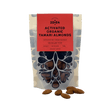
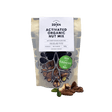


I’m Filip, from 2DiE4 Live Foods. And today I want to share something I said in our latest podcast interview – a sentence that sums it all up:
“It looks like a nut. But it isn’t a nut.”
This refers to the nuts you buy in the supermarket. The ones labeled “raw” or “unroasted.” In most cases, that’s not true. During industrial shelling, nuts are exposed to high temperatures – destroying a large part of what makes them valuable in the first place. You pay for nutrients you never actually get. That gap is exactly why 2DiE4 Live Foods exists.
The conversation you should watch
Agni and I were guests on Real Food Rebels, the British podcast by Hadrian Thomas from Katana Studio. He speaks with founders and brands who are changing the food space in a real way. No glossy marketing. No surface-level chat. Hadrian goes deeper and asks the questions that matter.
We talked about everything: how 2DiE4 started, what activation actually does to a nut, why it took us two years and custom-built machines before we were ready to sell our first product, and how Agni walked into Planet Organic in London with a plastic bag full of nuts – laying the foundation for everything that followed.
Watch the full episode now→What really happens during activation?
This is the question I get most often. And in the podcast, we went into detail. Raw nuts contain anti-nutrients. Phytic acid is the most well-known. It protects the nut in nature – but in your body, it binds minerals like iron, zinc, and magnesium and prevents their absorption. In addition, there are enzyme inhibitors that slow down digestion and can cause bloating and intolerance in sensitive individuals.
Our activation process solves this. In two steps:
Step 1: Soaking. The nuts are soaked in pure spring water from our farm in Upper Bavaria and hand-harvested sea salt. This initiates the fermentation process. Phytic acid is broken down. Enzymes are activated. The nut begins to “wake up.”
Step 2: Gentle drying. We then dry the nuts at a maximum of 65°C over several days. No roasting. No overheating. All heat-sensitive vitamins, enzymes, and nutrients are preserved. The result is that signature crunch – light, crisp, clean.
The process sounds simple. It isn’t. Like baking bread or brewing beer, the result is built on years of experience and precise craftsmanship.
Why are there more nut allergies today?
We addressed this in the podcast as well – and the answer surprises many people. Industrially processed nuts are exposed to temperatures during mechanical shelling that alter protein structures. The human immune system reacts more strongly to these altered proteins than to their original form. On top of that, there are pesticide residues, artificial preservatives, and processing methods that turn a living nut into a dead product.
Many people who react to conventional nuts – itching in the throat, digestive issues, bloating – tolerate our activated nuts without problems. That is not a coincidence. That is science and craftsmanship.
Where our nuts come from
Agni personally visits every single farmer. She walks the fields. She observes how the nuts grow, how they are harvested, and how they are stored. These relationships have been built over more than a decade.
Our walnuts come from Bulgaria. Our almonds from Spain. Our pecans from South Africa. The spring water comes directly from our Gut Mooseurach farm in Königsdorf, in the Bavarian Alps. The sea salt is hand-harvested – from Brittany and Croatia.
Farm. Production. To you. Nothing in between.
This is not just a statement. It is our operating model. No middlemen diluting standards. No anonymous supply chain where you don’t know what happened to your nuts.
Hadrian also continued the conversation in his blog
After the podcast, he published his own piece about our conversation and our brand. Hadrian is a brand expert with a sharp eye for what sits beneath the surface of real food brands.
He writes about how we went from a plastic bag in London to a brand now supplying customers across Europe and the UK. He explains what it means to charge double for a product – and why it is justified when the nut actually delivers what it promises.
His conclusion is simple: anyone who genuinely cares about what’s in their food and where it comes from will never look at a nut the same way again after this conversation.
Read the full blog post by Hadrian Thomas →
What makes a nut 2DiE4-worthy?
I get asked this often. The honest answer is: most nuts you can buy do not meet our standards. Not because we are perfectionists, but because the requirements are clear. Certified organic. Germinable – meaning alive enough to actually sprout. Grown by farmers who understand and respect their soil. No pesticides, no chemical preservation, no artificial additives.
Peanuts, for example, are deliberately not part of our range. Not because they are bad, but because they are legumes, not true nuts – and because, as the most widely produced “nut” in the world, they represent industrial processing that does not align with our approach.
The difference you can taste
When you try our nuts for the first time, you will likely say what hundreds of customers have told us: “I didn’t know nuts could taste like this.”
This is not coincidence and not marketing. Fermentation creates umami – the fifth taste. Complex, savory, deep. Bitter tannins are reduced. The natural sweetness of the nut comes forward. The result is a flavor completely different from anything you know from the supermarket. And then there is the crunch. Not hard. Not rubbery. Light, crisp, clean.
Watch it. Try it.
I invite you to watch the episode. Not because of us – but because the conversation provides real answers to questions most people never ask: what is really in my nuts? Why do I react differently to certain nuts? And what does “raw” actually mean?