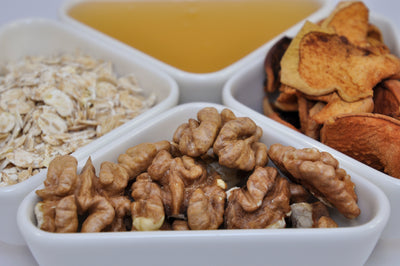




Imagine there was a food proven to protect your heart, strengthen your gut, stabilize your blood sugar, and yet almost no one eats enough of it. That is exactly the reality with nuts in Germany. And the numbers are strikingly clear.
“3 grams!
Not 3 handfuls.
Not 3 portions.
Three grams.
Per day.”
This is the result of the National Nutrition Survey II by the Max Rubner Institute, the most comprehensive study on dietary behavior in Germany. The German Nutrition Society (DGE) recommends at least 25 grams of nuts per day. That’s a small handful. We don’t even reach one eighth of that.
For comparison: the well-known PURE study (2017, over 135,000 participants across 18 countries) showed that people who regularly eat nuts have a significantly lower risk of cardiovascular disease. A meta-analysis in the British Medical Journal (Aune et al., 2016) found that just 28 g of nuts per day reduce the risk of coronary heart disease by 29% and overall mortality by 22%. One handful. Every day. And we don’t even reach 3 grams.
Why do we eat so few nuts?
The reasons are less physiological than cultural. Nuts have an image problem in Germany, and that has consequences for the health of millions of people.
Nuts are dismissed as a “snack”, not treated as a serious food with therapeutic potential. They barely appear in cafeterias, standard breakfasts, or food pyramids. Yet the DGE explicitly recommends them as a daily food group.
The fear of calories. Yes, nuts are energy-dense. But studies show the body does not fully absorb all calories from nuts, a significant portion is excreted undigested (Mattes & Dreher, 2010). Regular nut consumption has not been shown to cause weight gain. On the contrary, a JAMA study with over 118,000 participants even showed an inverse correlation.
Digestive discomfort. This is where it becomes personal. Many people do not tolerate conventional nuts well. Bloating, heaviness, intolerance. The reason: phytic acid and enzyme inhibitors found in raw, non-activated nuts. These natural defense compounds bind minerals and slow digestion. The result: you eat nuts for their nutrients, but your body cannot fully absorb them.
What we are missing:
The nutrient density of nuts
Nuts are not a side dish. They are one of the most nutrient-dense foods we know. A handful (25–30 g) delivers impressive amounts of essential micronutrients depending on the variety:

- Walnuts: Omega-3 fatty acids (ALA), polyphenols, vitamin B6, the only nut with relevant omega-3 content
- Cashews: Magnesium (83 mg/30 g), zinc, iron, tryptophan, important for sleep and mood
- Almonds: Vitamin E (7.7 mg/30 g), calcium, fiber, proven to stabilize blood sugar
- Pistachios: Lutein, zeaxanthin, potassium, plant protein, beneficial for eye health
- Brazil nuts: Selenium (up to 120 µg per nut), more than any supplement on the market provides
And yet we treat nuts like casual snack food for the evening.
The problem with “normal” nuts
The solution is not simply “eat more nuts.” Because raw nuts naturally contain phytic acid, tannins, and enzyme inhibitors. These compounds are the plant’s protective mechanism, preventing premature germination. But in your digestive system, they bind minerals like zinc, iron, and magnesium, making them inaccessible.
You eat nuts for nutrients, but your body only gets a fraction. It’s like taking an expensive supplement locked in packaging your stomach cannot open.
The solution is activation. In two steps:
Step 1: Soaking. The nuts are soaked in pure spring water from our farm in Upper Bavaria. This initiates the fermentation process. Phytic acid is reduced, enzyme inhibitors are neutralized. The nut begins to “wake up”, the germination process starts.
Step 2: Gentle drying. We dry at a maximum of 65 °C over several days. No roasting. No overheating. All heat-sensitive vitamins, enzymes, and nutrients are preserved. The result: that characteristic crunch, light, crisp, clean.
Our ancestors processed nuts this way instinctively, soaking and drying was standard. We have rediscovered and perfected this centuries-old process.
A handful a day
is all it takes
The science is clear: 25–30 g of nuts per day is enough to achieve measurable health benefits. That equals 8–10 cashews, 7 walnut halves, or 23 almonds. It fits in any pocket, desk drawer, or backpack.
If these nuts are activated, one key advantage is added: your body can actually absorb the nutrients. No bloating. No heaviness. Real utilization instead of expensive fiber transit.
Forget supplements, forget complex nutrition plans. A handful of activated nuts is the simplest thing you can do for your health today:
- Morning: With muesli or porridge, protein and healthy fats to start the day
- Midday: 15 minutes before meals, proven to stabilize blood sugar
- Afternoon: As a snack instead of a chocolate bar, satisfying without a crash
- Evening: With salad or on their own, tryptophan from cashews supports sleep
Germany does not have a nutrition problem,
it has a nut problem
3 grams instead of 25. This is not coincidence, but a systemic failure. Nuts are not prominently featured in school cafeterias or nutrition pyramids. Yet research clearly shows: no other food group offers a comparable ratio of nutrient density to portion size.
And when these nuts are activated, meaning fermented, with reduced phytic acid and maximum bioavailability, a good habit becomes one of the best decisions you can make for your health. Every day. With a handful.
Frequently asked questions
Why does the DGE recommend 25 g of nuts per day?
Because numerous long-term studies show this amount significantly reduces the risk of cardiovascular disease, type 2 diabetes, and overall mortality. The evidence is strong enough that nuts are recommended in nearly all international dietary guidelines.
Don’t nuts make you gain weight?
No. Despite their high energy density, studies consistently show that regular nut consumption does not lead to weight gain. The body does not absorb all calories from nuts, and they increase satiety, which can even reduce total calorie intake.
What is the difference between activated and regular nuts?
Activated nuts are soaked and slowly dried below 65 °C. This reduces phytic acid, breaks down enzyme inhibitors, and increases nutrient bioavailability. Digestibility improves noticeably, and many people who cannot tolerate regular nuts have no issues with activated ones.
Sources:
- Max Rubner Institute (2008): National Nutrition Survey II
- German Nutrition Society (DGE): 10 rules of the DGE
- Aune, D. et al. (2016): Nut consumption and risk of cardiovascular disease. BMJ, 353, i1394
- PURE Study (2017): de Souza, R.J. et al., Lancet, 135,000 participants, 18 countries
- Mattes, R.D. & Dreher, M.L. (2010): Nuts and healthy body weight maintenance. Asia Pacific J Clin Nutr
- JAMA Internal Medicine (2013): Bao, Y. et al., 76,000 women, 42,000 men