



“28 grams of nuts per day reduced the risk of coronary heart disease by 29%.”
Meta-analysis, British Medical Journal, 2016 · 29 studies · 819,000 participants
I read that number and think: If this were a drug, every doctor would prescribe it. But it isn’t a drug. It’s a handful of nuts.
My name is Filip. I’ve been with 2DiE4 Live Foods since 2020. Agni, my business partner, founded the company in 2004 with her late husband. Back then, he walked into Planet Organic in London with a plastic bag full of activated nuts and said, “Try these.” That was the beginning. Twenty years later, we know: these nuts earn their place not just because they taste incredible, but because of what the research now proves.
The three studies that proved everything
RESEARCH
Nutrition studies contradict each other all the time. Eggs are healthy. Eggs aren’t healthy. Coffee helps. Coffee harms. When it comes to nuts and heart health, these contradictions don’t exist. The evidence has pointed in the same direction for five decades.
PREDIMED (2013): Over 7,000 participants in Spain. Randomized. Controlled. The group that ate 30 g of mixed nuts daily had a 30% lower risk of major cardiovascular events. The study was stopped early — not because it failed, but because the results were so clear that denying the control group nuts any longer was unethical.
PURE (2017): 135,000 participants. 18 countries. 5 continents. Those who ate two or more servings of nuts per week had a 23% lower risk of death — independent of income, background, or diet style.
Aune et al. (BMJ, 2016): The most comprehensive meta-analysis to date. 29 studies. Over 800,000 people. The result: 28 g of nuts per day reduced heart attack risk by 29%, stroke risk by 7%, and overall mortality by 22%.
28 grams. That’s 7 walnut halves. Or 24 almonds. Or 18 cashews. It fits in any pocket.
The question isn’t whether nuts protect the heart.
The question is: why do most people eat less than 5 grams per day? More here.
Which nut protects the most?
NUT RANKING
In our podcast with Hadrian Thomas from Katana Studio, I said: “It looks like a nut. But it isn’t a nut.” I meant supermarket nuts — heated so intensely during industrial processing that most bioactive compounds are destroyed. The data here refer to real, gently processed or even better — activated — nuts.
Walnuts are the leaders among nuts because they’re especially rich in ALA (alpha-linolenic acid) — a vital form of omega-3 fatty acids. With an ALA content of 8–14% of total fat, they’re unique among tree nuts. 30 g provide 2.7 g ALA, which is more than a full day’s requirement. In a controlled study, 30–60 g of walnuts per day reduced total cholesterol by 5.4% and LDL by 6.8% within 8 weeks. At 2DiE4, we call walnuts the “gateway nut.” Because with them, you taste the difference between conventional and activated most clearly: the bitterness disappears, the creamy, nutty flavor comes through.
Almonds are the vitamin E champions. 30 g deliver 7.7 mg of vitamin E — 50% of your daily requirement. Vitamin E protects LDL cholesterol from oxidation. And oxidized LDL — not LDL itself — is the real trigger for atherosclerosis.
Pistachios lower blood pressure. A meta-analysis of 21 studies: regular pistachio consumption reduces systolic blood pressure by 1.82 mmHg. They also contain more melatonin than any other food.
Cashews provide magnesium. 83 mg per 30 g. Magnesium relaxes vascular muscles and regulates heart rhythm. Roughly one in four adults is under-supplied.
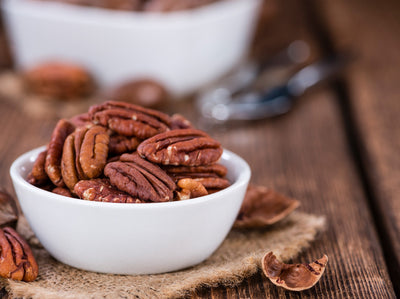
Pecans have the highest antioxidant levels of all tree nuts (ORAC value 17,940). Almost twice as much as walnuts.
What most people get wrong
THE BLIND SPOT
In the podcast, Agni describes what happens in modern processing facilities: “They have huge cylinders, like a round train car. The nuts go inside and get dried at well over 100 degrees.” What’s labeled “raw” in supermarkets isn’t truly raw anymore.
The consequence for your heart is direct:
- Omega-3 fatty acids oxidize above 150 °C and form free radicals
- Up to 40% of vitamin E is lost
- Polyphenols denature
- You eat nuts for their heart benefits — and instead of antioxidants, you get pro-oxidants
What we do differently at 2DiE4
It took Agni 12 years to find the right farmers. She visits every single farm, walks the fields, looks at how the trees grow. Our walnuts come from Moldova, our almonds and pistachios from Spain, our pecans from South Africa.
Then our activation begins: soaking in our own spring water from Gut Mooseurach in Königsdorf, at the foothills of the Bavarian Alps. Plus hand-harvested sea salt from Brittany and Croatia. Then gentle drying in our custom dehydrators — now in their fourth generation — at a maximum of 65 °C. Two and a half days. More air than heat.
The result: every heart-protective molecule stays intact. And the phytic acid that otherwise blocks magnesium and zinc is reduced significantly.
Five mechanisms, one goal
SCIENCE
1. Cholesterol reduction. 80% of fatty acids in nuts are unsaturated. They replace saturated fats and directly lower LDL.
2. Anti-inflammatory effect. Polyphenols from walnuts inhibit NF-κB, the central inflammation switch. In one study, 43 g of walnuts per day lowered IL-6 by 11.5%. More in our inflammation article.
3. Vasodilation. L-arginine in nuts converts to nitric oxide, which relaxes arteries and improves blood flow.
4. Antioxidant protection. Vitamin E, selenium from Brazil nuts, and polyphenols prevent LDL oxidation. And oxidized LDL is the real plaque builder.
5. Blood sugar regulation. Nuts before a meal blunt the glucose rise by up to 30%. Fewer glucose spikes mean less vessel damage. The full blood sugar hack.
All heart-protective varieties in one pack
2DiE4 ALL-IN-ONE Set
7 × 100 g activated organic nuts. Free shipping across DE/AT.
Walnuts + cashews + pistachios + almonds + pecans + pumpkin seeds + nut mix
★★★★★ 4.9/5 · 62+ reviews · Handmade in Bavaria
How much. How often. When.
PRACTICE
Amount: 25–30 g per day. The dose-response curve flattens after that.
Frequency: At least 3–4 times per week. The PREDIMED study showed: occasional intake had no measurable effect. Consistency is what counts.
Timing: Before meals maximizes the blood sugar–dampening effect. In the evening, you benefit from the tryptophan in cashews and melatonin in pistachios.
Variety: The mix makes the magic. In the podcast, I ask Agni for her favorite product. Her answer: “It changes all the time. I listen to my body.” Sometimes pistachios, sometimes pumpkin seeds, sometimes almonds. Our Portuguese farmer does something similar: he puts different varieties on the table and lets the kids choose. “The kids always pick the best ones,” he says. “Then I know which tree to plant more of.”
Your body knows what it needs. Give it the choice.
One handful a day.
10 questions and answers
KNOWLEDGE
1. Which nut protects the heart best?
Walnuts have the strongest single evidence thanks to 8–14% omega-3 (ALA). But you get the broadest benefit from variety. Each nut has its specialty: walnuts for cholesterol, pistachios for blood pressure, cashews for magnesium, Brazil nuts for selenium.
2. Are 28 grams really enough?
Yes. The Aune meta-analysis (BMJ 2016) shows: 28 g per day reduces heart attack risk by 29%. More isn’t significantly better. A small handful. Every day. That’s the key.
3. Do nuts actually lower cholesterol?
Yes, especially LDL. In controlled studies, walnuts lowered LDL by 5–7%. Almonds protect LDL from oxidation. The effect is stronger with activated nuts because heat-sensitive compounds remain intact.
4. Why are roasted nuts less effective?
Temperatures above 150 °C destroy omega-3, vitamin E, and polyphenols. The fats oxidize and form free radicals. At 2DiE4, we dry at a maximum of 65 °C for two and a half days. More air than heat.
5. What does activation do to heart-protective nutrients?
Two things: first, all heat-sensitive compounds remain intact (omega-3, vitamin E, polyphenols). Second, phytic acid — which would otherwise block magnesium and zinc — is broken down significantly. You get more of what your heart needs.
6. Don’t nuts make you gain weight?
No. Despite their high energy density, studies consistently show: regular nut consumption does not lead to weight gain. The body doesn’t absorb all calories from nuts, and their satiety effect reduces total calories across the day.
7. Can nuts replace heart medication?
No. Nuts don’t replace prescribed medication. But they can support treatment. The PREDIMED study showed: nuts worked in addition to existing medications. Talk to your doctor.
8. How quickly do nuts affect the heart?
Cholesterol reduction: measurable after 4–8 weeks. Blood sugar stabilization: immediate (within 30 minutes). Long-term protective effect (mortality reduction): in studies after 2–5 years of regular intake.
9. Omega-3 from walnuts vs. fish: which is better?
Walnuts provide ALA (plant-based omega-3); fish provides EPA/DHA. Both forms are cardioprotective. For vegetarians and vegans, walnuts are the key omega-3 source. 30 g cover the full daily ALA requirement.
10. Is there a product that combines all heart-protective nuts?
The 2DiE4 ALL-IN-ONE Set contains all 7 varieties: walnuts (omega-3), cashews (magnesium), pistachios (blood pressure), almonds (vitamin E), pecans (antioxidants), pumpkin seeds (zinc), and the nut mix. 22% cheaper than buying individually. Free shipping.
Sources:
- Aune, D. et al. (2016): Nut consumption and risk of cardiovascular disease. BMJ, 353, i1394
- Estruch, R. et al. (2013): Primary Prevention of CVD with a Mediterranean Diet (PREDIMED). NEJM, 368(14)
- Dehghan, M. et al. (2017): PURE Study. The Lancet, 390(10107)
- Ros, E. et al. (2018): Effect of walnut consumption on inflammatory markers. Nutrition Reviews
- Real Food Rebels Podcast (2025): Filip Good & Agni Thalgott in conversation with Hadrian Thomas, Katana Studio